Research
Published & Working papers
[1] Ghosh, S., & Singh, J. (2026). Eliciting Supplier Cooperation for Value Chain Decarbonization: A Field Experiment with Smallholder Farmers in India.
- Job Market Paper, forthcoming Management Science (link)
- Nominated for SMS Annual Conference (2023) Best Responsible Research Paper Prize & PhD Paper Prize Competition.
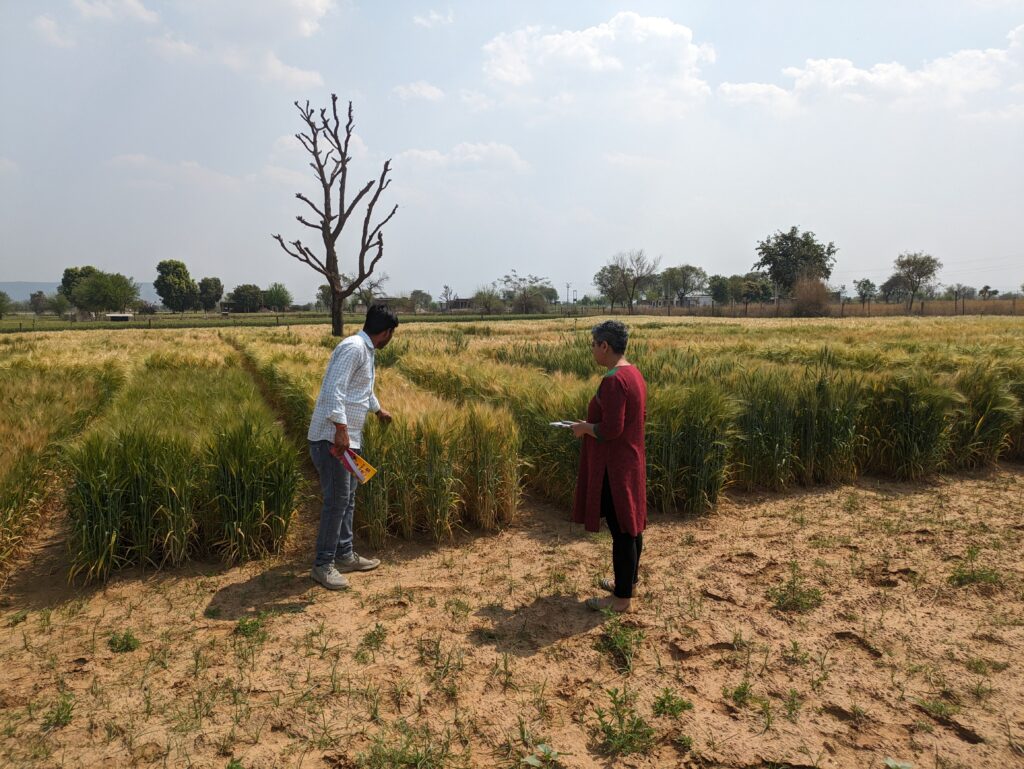
Abstract: Many firms are pledging to reduce greenhouse gas emissions across their value chains. However, this requires their suppliers to also adopt more climate-friendly practices for decarbonization. This can involve addressing gaps in not only the suppliers’ ability but also their willingness to adopt such practices, which can be challenging if the suppliers perceive the practices as risky or potentially detrimental to their economic well-being. We examine the effectiveness of relational investments to help mitigate this challenge, arguing that relational investments can serve as a signal of the firm’s commitment towards joint value creation. In a field experiment conducted with supplier farmers in a multinational firm’s agricultural supply chain in India, we examine the impact of two kinds of relational investments in providing the farmers with customized agricultural services that they valued. In the first intervention, the firm’s field officers offered the farmers support specific to the crop the firm sourced from them. The second intervention additionally involved bringing in expert agronomists to provide the farmers with support also on broader agricultural matters of interest to them. Relative to a control condition in which the farmers only received training on the relevant climate-friendly practices, both interventions improved the farmers’ adoption of the recommended practices. The second intervention was more impactful than the first in improving the farmers’ practice adoption as well as their retention with the firm. Exploratory mediation analysis and post-experiment field interviews suggest that these findings are partly driven by the farmers’ positive perception of the firm’s relational investments.
[2] Ghosh, S., & Kivleniece, I. (2026). It Takes a Village to…: Firms, Collectives and Firm-Community Governance Forms for Addressing Grand Challenges.
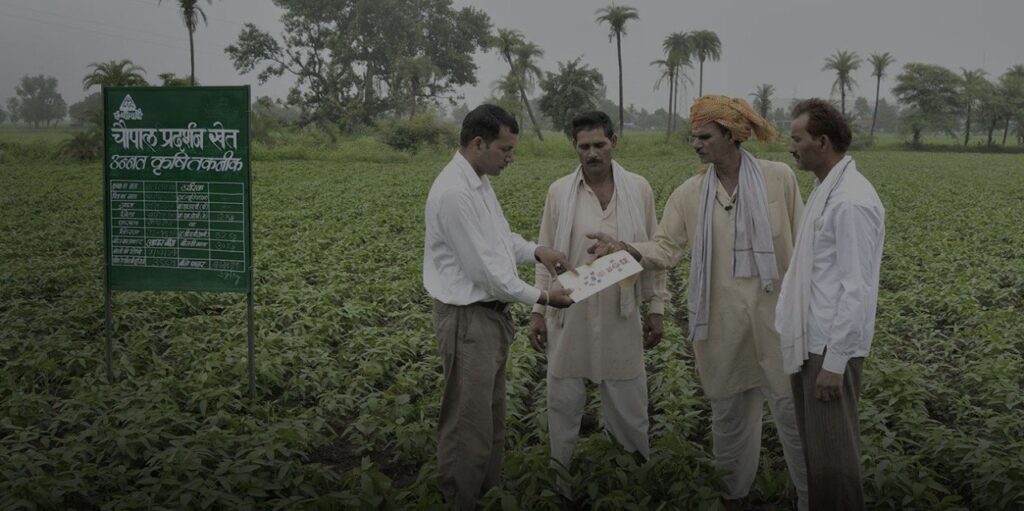
Image source: ITC e-choupal
Abstract: We develop a theoretical framework that specifies the conditions under which firm–community governance arrangements offer comparative efficiency in addressing grand challenges. Building on a comparative governance perspective, we identify three mechanisms through which firm–community governance may deliver greater social value: through translation (bridging global and local knowledge), stewardship (balancing autonomy with coordination), and value allocation (integrating efficiency and equity considerations). We argue that firm–community governance may create superior value when grand challenges are characterized by high local instantiation, substantial stakeholder heterogeneity, and significant distributional equity requirements. Our framework contributes to understanding how firm–community organizing can address complex societal problems, extending the traditional hierarchy-market dichotomy to novel forms of economic organizing.
[3] Ghosh, S., Sevcenko, V., & Singh, J. (2025). Interdependent Agendas in Sustainability: Examining Trade-off between Decarbonization and Workforce Diversity.

Image source: FT, 2023
Abstract: Environmental sustainability and workforce gender diversity represent two critical societal priorities increasingly prominent in corporate agendas. However, corporate sustainability research provides limited insight into potential interactions between sustainability dimensions, often implicitly assuming independence across them. We document how efforts to advance decarbonization through green jobs creation are associated with lower female representation in these positions. Using detailed online job profile data from over 16 million positions across 713 U.S. Fortune 1000 firms (2011-2022), we identify geographic concentration as a key mechanism driving this trade-off. Green jobs tend to cluster in specific locations, creating barriers for women who face documented mobility constraints stemming from family responsibilities and commuting preferences. We find that green jobs in metropolitan areas and those with greater remote work flexibility show significantly smaller gender gaps. These findings challenge the assumption that sustainability dimensions can be pursued independently, highlighting how structural factors embedded in broader systems create interdependencies between environmental and social objectives. We contribute to emerging literature on sustainability trade-offs by demonstrating how organizational design choices can help firms better manage competing priorities and advance multiple sustainability goals simultaneously.
Research in Progress
Image source: www.agritalent.com
[4] Organizing adoption decision as a collective act in the adoption, diffusion, (and persistence) of sustainable agriculture: Engaging Resource-Constrained Supplier Farmers in India [data analysis in progress, with Habin Jung and Rupali Kaul (INSEAD)]

[5] Scaling Up Corporate Sustainability Initiatives in the Agricultural Value Chain in India [multiple study designs in progress as part of a multi-year research program].